
The 2025 12 Days of Trust Ventures Christmas
Dear Trust Ventures friends, founders, and limited partners,
We hope you are all enjoying the holiday season, and that this year has been a happy, healthy, and fruitful one for you and your families.
During this time, we typically reflect on the past year by publishing our 12 Days of Trust Ventures Christmas. For those of you who are unfamiliar, here is a snippet of last year’s:
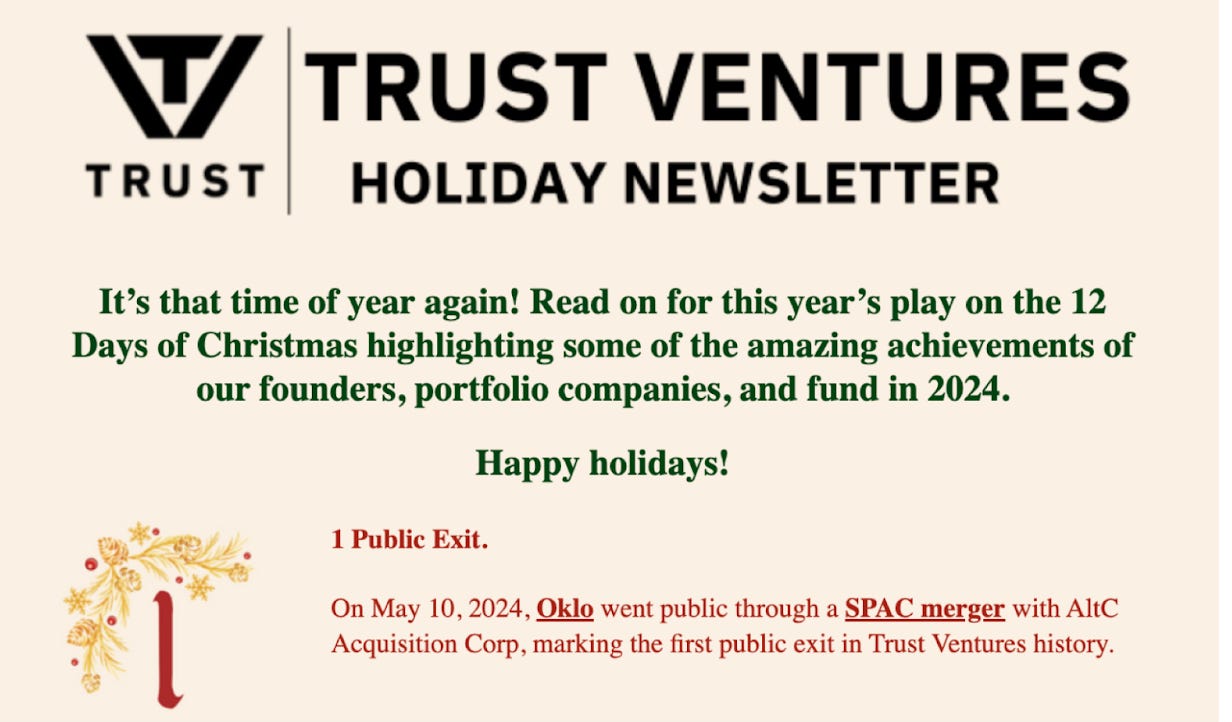
Beginning last year’s list with our first public exit as a fund was a big moment for us, and that momentum has only accelerated this year, which has surpassed even our own (very high) expectations of what we thought possible.
For the past seven years we have invested in companies that enter the hardest markets in the world, like energy, manufacturing, and healthcare. But this year has marked a turning point. Base Power raised a $1B Series C round and the White House passed a series of executive orders to remove barriers for Oklo and other nuclear innovators, driving Oklo to 400x our blended entry valuation. Moments like these prove that what began as an experiment in regulatory venture has become a repeatable model.
Now, as we take the time to reflect on the past year, it seems like an opportune time to not only celebrate our wins as a fund, but explain why we believe this is a watershed moment for all of venture capital.
The New Industrial Revolution
The industrial revolution was sparked by a confluence of enabling technologies: the steam engine, electric light, structural steel, and most importantly, the oil pipeline. Without these, we would have never gotten Ford and the assembly line.
Now, it is very easy to believe that we are at the precipice of another industrial revolution. The steam engine augmented our physical abilities; AI is augmenting our mental ones. At the same time, robots offer better, stronger tools to shape and transform our physical world, while cheap baseload electrons from new energy sources give us the energy to power them.
Internally, we refer to these three forces as brains (AI), brawn (robots), and power (energy). Any one of these forces alone could power a trillion dollar expansion. And the synergies between them would promise even richer rewards in the coming decade–but only if coupled with a sufficiently open regulatory regime, as we had in the last Industrial Revolution.
The Bottleneck
At the same time that brains, brawn, and power are coming together to shepherd in a new industrial revolution, the problems we face are becoming more severe. Global energy demand is skyrocketing, the electric grid is aging, transmission is becoming constrained, and new infrastructure is simply not being built at the pace we need it to be.
Frustratingly, many of these problems have been solved from a technological standpoint, but those solutions lie stranded in a regulatory quagmire.
Instead of looking to the immutable laws of physics for solutions, our brightest entrepreneurs must sort through an endless list of outdated and Byzantine regulations, then mutate their technology to fit those constraints. At best, this decreases efficiency and quality, but often, it keeps critical technology from ever leaving the lab at all.
Every regulation encodes a belief about how the world works: what is safe, who may participate, what risks are tolerable, etc. But, unlike technology, which is dynamic and competitive, the law is static; it grows old, loses relevancy, and only changes if you make it change.
We do not lack the physics or engineering expertise to grow GDP by 4-5% per year, but the technologies we need cannot get to market if regulation remains static.
The Opportunity
Most venture capital funds think of regulation as a constraint to be avoided. We treat it as a lever. Outdated and incumbent-driven rules distort incentives, raise costs, and trap innovation behind procedural walls. Unlocking those walls is not an act of charity or politics; it is one of the purest forms of value creation.
Over the past 25 years, America’s potential growth rate (what the economy could achieve if new technologies reached market efficiently) has been roughly 4%. Actual growth has hovered closer to 2%. That 2-point delta compounds dramatically over time. Closing even half of it would double living standards within a generation.
Each permitting delay, each obsolete code requirement, and each barrier to entry reduces productive capacity just enough to go unnoticed, yet together they add up to a meaningful drag on national growth. Likewise, when an outdated rule is modernized, the market begins to move back toward equilibrium.
For most of its history, venture capital has sought to reduce technological inefficiency, focusing on cheaper computation, faster logistics, and better user interfaces. Today, we are still making improvements on all of these fronts, but the greater inefficiency is institutional. The regulatory state is now one of the largest sources of trapped value in the economy. Across energy, manufacturing, and healthcare, entire markets operate below their productive frontier because the laws on the books don’t account for today’s (and certainly not tomorrow’s) technology.
Each patch of outdated regulation marks a point of friction where new entrants cannot yet compete on merit; reforming those rules creates not just one company’s advantage but an open field of new demand, supply, and growth.
The Fund
If regulation is the modern economy’s most persistent bottleneck, then solving it requires a team built for that terrain. From the beginning, we knew that a traditional venture model could not deliver this kind of value on its own. Technical diligence and capital allocation are necessary but insufficient. What matters just as much is the ability to navigate the complex machinery of law, policy, and politics.
We built Trust Ventures around that recognition. Our team combines the skills of former lawyers and policy experts with experienced operators and engineers. When a portfolio company encounters a policy barrier, we’re in the trenches with them, helping them navigate the policymaking process, organize stakeholders, educate policymakers, and reach the right audiences.
This strategy compounds learning across markets. Each time we help a founder open a closed market, whether by modernizing a licensing statute, updating a building code, or reforming a permitting process, we capture not only the return from that investment but also the institutional knowledge that applies to the next.
The 2025 Trust Ventures 12 Days of Christmas
We see more abundant power, intelligence, and labor intersecting to remake industries. But first, we must be willing to rethink and revise decades and centuries-old regulatory obstacles that unnecessarily hold these breakthroughs at bay. If we do this, the rewards for our economy and society at large are unimaginable.
With that, we are excited to present the 2025 Trust Ventures 12 Days of Christmas.
$1 Billion. Base Power raised a $1B Series C round led by Addition with participation from Trust Ventures, Thrive Capital, Capital G, Lightspeed, Yale, UTIMCO, Elad Gil, and others.
2 MW Production Capacity. Antora built the world’s first dedicated thermophotovoltaic (TPV) cell manufacturing line at their Sunnyvale HQ. It has an initial production capacity of 2 MW, making it the world’s largest producer of TPV.
π*0.6 is unveiled. On November 17, 2025 Physical Intelligence published a paper introducing π*0.6, an AI model that helps robots understand the physical world and learn through real-world experience. It’s already powering robots that fold laundry, make espresso, and assemble cardboard boxes.
4 Executive Orders. On May 23, 2025, Oklo CEO Jacob Dewitte stood in the Oval Office as President Trump signed 4 executive orders on nuclear energy to expand domestic capacity, ease parts of the regulatory regime, and tie nuclear energy more directly to national security and rising AI demand.
5 MW of Electricity. Oklo’s proposed microreactor at Eielson Air Force Base, Alaska would deliver 5 megawatts of electricity to power the base’s essential operations.
6 Hundred Million Dollars. Physical Intelligence raised a $600M Series B from CapitalG with participation from Trust Ventures, Thrive Capital, T. Rowe Price, Jeff Bezos, Lux Capital, and others.
7 Day Timeline. GreenLite delivers first plan-review comments in 7 days, cutting down the overall time it takes to get a building permit by 75%. Today, they offer private plan review to more than 100 customers, and in September 2025 they raised a $49.5M Series B led by Insight Partners to scale this model nationwide.
8 inches and 5 feet tall. Apptronik’s humanoid robot, Apollo, is 5’8, weighs 160 pounds, and can lift up to 55 pounds. Apollo is currently deployed across a number of pilots, including Mercedes-Benz, GXO Logistics, and Jabil.
9 New Portfolio Companies. We added 9 new companies to the Trust Ventures portfolio this year, including Wetstone, Physical Intelligence, Voya, and a few others we can’t mention yet…
10+ Countries. Wetstone is engaged in more than 10 countries, where they are pursuing deep sea mining projects to bolster America’s supply of critical minerals.
11/12/25. On November 12, 2025, Voya announced their $13M seed round led by Energy Impact Partners with participation from Trust Ventures, Founders Fund, 8090 Industries, Overmatch, and others.
12 Follow-on Checks. We doubled down this year by writing 12 follow-on checks into existing Trust Ventures portfolio companies.
America’s best days lie ahead, but only if we can get out of our own way.
Happy Holidays,
Salen Churi and Brian Tochman